

I've hurt my AC Joint. What should I do?
by Margie Olds
An acromioclavicular (AC) joint injury, often called an ACJ injury, affects the joint where the collarbone meets the shoulder blade. It commonly happens when someone falls onto the point of the shoulder or lands on an outstretched hand.
Safety note: This article is for general information only. Your injury grade and treatment should be assessed by a qualified healthcare professional. Use a brace only when it is appropriate for your injury and as advised by your clinician.
Looking for support while your AC joint heals?
Explore the ACJ Shoulder BraceWhat is the AC joint?
The AC joint is held together by three important ligaments: the acromioclavicular ligament, the trapezoid ligament and the conoid ligament. The trapezoid and conoid ligaments are also known as the coracoclavicular ligaments because they both originate on the coracoid process.

How are ACJ injuries graded?
ACJ injuries are graded according to the amount of ligament damage and the direction and degree of clavicle displacement. Your healthcare professional will assess the injury and determine its grade. The images below show the typical features of Grades 1 to 6.
Grade 1
A Grade 1 injury is a sprain of the AC joint capsule. It usually causes localised tenderness over the joint and pain with movement, especially when bringing the arm across the body.

Grade 2
A Grade 2 injury involves a rupture of the AC ligament and a sprain of the coracoclavicular ligaments, the conoid and trapezoid. It can cause a small bump at the top of the shoulder, known as a step deformity, along with localised tenderness.
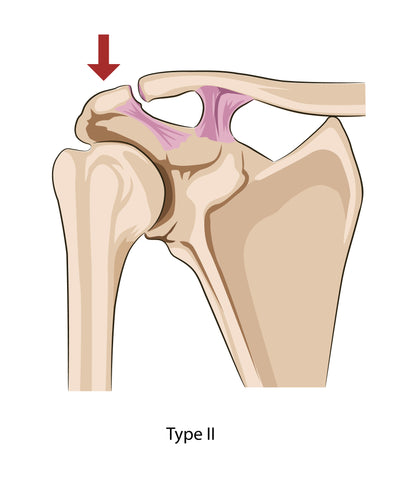
Grade 3
A Grade 3 injury involves a complete rupture of the AC, conoid and trapezoid ligaments. It causes a marked step deformity, although the displacement is less pronounced than with a Grade 5 injury.
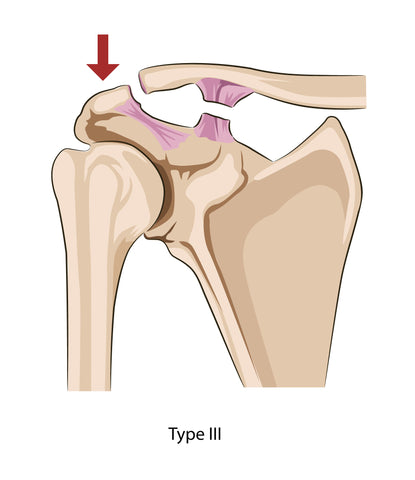
Grade 4
A Grade 4 injury involves a complete rupture of all three ligaments, with the clavicle displaced backwards, or posteriorly.

Grade 5
A Grade 5 injury is also a complete rupture of all three ligaments, with the clavicle displaced upwards, or superiorly. The upward displacement is greater than with a Grade 3 injury.

Grade 6
A Grade 6 injury involves a complete rupture of all three ligaments, with the clavicle displaced downwards, or inferiorly. This type of injury is very rare.

What happens next?
The grade of your injury helps guide treatment. Grades 1 to 3 are often managed with physiotherapy, pain management and scapular strengthening, with many people seeing improvements in pain and function over approximately 4 to 6 weeks. Some Grade 3 injuries that do not respond to rehabilitation may need further surgical assessment.
Grades 4 to 6 may require a surgical opinion. Your healthcare professional can explain the treatment options that are appropriate for your injury and recovery goals.
Returning to activity after an ACJ injury? Once your healthcare professional has cleared you to progress, a padded brace may provide support and protection during recovery.
Explore the ACJ Shoulder BraceThe Flawless Motion ACJ brace provides all-over shoulder support. Its padded strap is designed to provide protection during a return to sport, while the additional straps can support the scapula and AC joint as it heals. It should complement, not replace, the advice of your healthcare professional.


